
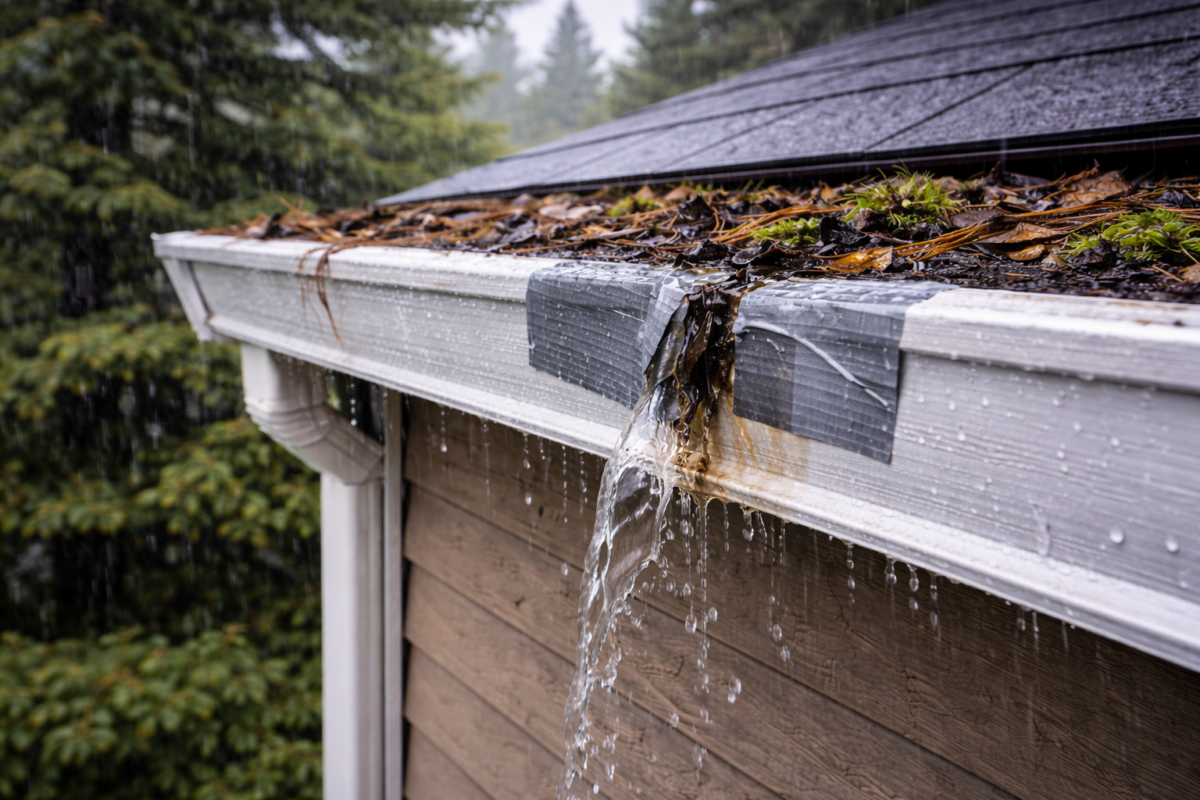
In Oregon, a small gutter issue really is like a single snowball at the top of a hill. It feels easy to ignore at first. Maybe it is just a drip. Maybe one corner looks slightly loose. But with how long everything stays wet here, that little problem rarely stays put.
Understanding the difference between minor, affordable fixes and early signs of major failure is one of the best ways to control your gutter repair costs. Some problems stay in the “service call” category. Others start pulling you toward more significant structural damage and, eventually, gutter replacement.
In this article, we will break down which issues usually stay small and which ones tend to snowball into something much more expensive.
Quick Answer:
In Oregon’s wet climate, small gutter problems—like loose seams, minor sagging, or isolated clogs—usually stay affordable when repaired early through resealing, rehanging, or cleaning. Costs begin to snowball when moisture repeatedly soaks fascia boards, pitch problems cause standing water, or multiple sections fail at once, pushing the project toward structural repairs or full gutter replacement. Acting at the first sign of leaks or overflow keeps most repairs in the “service call” range instead of the multi-thousand-dollar range.
The “Stay Small” Repairs
Most homeowners are willing to pay for repairs when they are simple and contained. That is the good side of gutter repair. These are early, proactive fixes that protect the system before water starts finding other pathways.
Resealing Minor Leaks
Small leaks tend to start quietly. A seam opens just enough for water to drip through. An end cap loosens over time. During a steady Oregon rain, those little gaps can stay active for hours.
Resealing is one of the most common small-scale gutter repairs because the gutter itself is still fine. You are just closing the weak point before the water spreads.
Re-securing Loose Gutters
A loose gutter often looks minor at first. One section sags. The line does not sit as tight as it used to. Maybe you notice water spilling over the edge during a heavier storm.
When the fascia behind the gutter is still solid, rehanging or tightening a few fasteners can restore alignment. This is the kind of gutter repair that stays in the “fix it now and move on” category.
Oregon’s weather accelerates this problem because debris is rarely dry. Wet leaves and pine needles carry weight. That extra load pulls harder on hangers, turning one loose bracket into a sagging section if nobody intervenes.
Clearing Isolated Blockages
Sometimes the issue is not the gutter structure. It is a clogged area where water cannot flow.
Overflow is often the start of a bigger chain reaction. Water spills behind the gutter, runs down the trim, and starts soaking areas that were never meant to stay wet.
Water damage is not a rare problem. Insurance data tied to ISO and Verisk show that water damage and freezing claims averaged about $15,400 in severity from 2019 to 2023. The same dataset indicates that about one in 67 insured homes experiences this type of claim each year. That puts overflow into a much higher-stakes category than most people realize.
The “Snowball” Repairs
Some problems cross a line where patching no longer makes sense. The system starts failing in multiple places, or the structure supporting it breaks down.
Extensive Fascia Rot
Fascia rot is one of the clearest snowball problems. At this stage, the gutter does not simply pull loose due to a faulty hanger. It pulls loose because the wood behind it can no longer hold anything securely.
Once that happens, the gutter will be rehung temporarily. The system needs a solid structure again to function.
Codes even treat roof drainage systems as something that must be maintained and kept free of obstructions, which shows how closely gutter failure connects to basic property upkeep, not just appearance.
For Oregon homeowners, fascia rot occurs more quickly due to prolonged moisture. Soft wood does not bounce back. It gets worse.
Multiple Failed Sections
One leak is repairable. Five leaks across a long run is a different story.
When several areas break down, repairs become repetitive. Rust accumulates, joints loosen over time, and the gutter system begins to fail as a whole.
In these cases, homeowners often end up paying repeatedly for gutter repairs without getting long-term reliability. That is usually when gutter replacement becomes the more practical investment, even if the upfront gutter replacement cost feels intimidating.
Chronic Pitch Problems
Pitch issues can be frustrating because cleaning does not solve them. Water still sits, overflow continues, and the same areas remain at risk.
Standing water accelerates rust and seam breakdown. It also increases the risk of water spilling toward the foundation.
Flood damage data adds another layer here. FEMA’s FloodSmart program reported $8.8 billion in U.S. flood damage in 2024, with $3.8 billion occurring in communities not considered high-risk. That is a reminder that water issues do not stay neatly contained.
A gutter system that cannot drain properly puts the home at risk.
Why Oregon’s Climate Makes Snowballs Roll Faster
Oregon accelerates gutter problems because moisture acts like an accelerant. A small rust spot does not pause for weeks. It keeps progressing. Minor wood softness turns into rot.
Debris weight also matters. Wet buildup pulls down on hangers and seams. One loose connection becomes a strain across the whole line.
This is the real cascade effect. One leaking seam saturates the fascia. The fascia weakens. Nearby sections lose support. Pitch worsens. Standing water develops. Problems multiply.
Climate patterns reinforce urgency. Oregon precipitation ran below average in 18 of the last 24 water years. The 2024 water year is the fourth-warmest on record. These swings create runoff and debris cycles that quickly stress gutters.
Early Investment vs. Emergency Replacement
The financial difference between small fixes and snowballed failures is, honestly, dramatic.
A planned repair often stays in the few-hundred-dollar range, with typical repair costs between $195 and $625 and an average of around $385.
Once failure becomes systemic, the conversation shifts to gutter replacement costs, which can run into the thousands depending on the system length and complexity.
The value of inspection comes down to clarity. A professional can tell the difference between a simple rehanging job and fascia damage that will not hold fasteners. An accurate diagnosis prevents wasted spending and keeps your gutter repair costs from escalating unnecessarily.
Stop the Cascade Before It Starts
The best way to manage gutter repair costs is through informed, timely action. Minor issues such as resealing, rehanging, and clearing clogs remain affordable because they protect the drainage system before water starts to spread into the structure.
Once fascia fails or multiple sections break down, repairs become substantial. That is when gutter replacement becomes unavoidable, and the financial jump feels steep.
If you want a clear, honest assessment, let Gutter Empire Oregon take a look before the snowball starts rolling. Call us at (971) 777-9899, click here for a free estimate, or contact us to schedule an inspection and keep your gutter repair needs small and manageable.
Key Takeaways
- Small repairs stay affordable when handled early.
Resealing seams, tightening hangers, or clearing a blockage usually keeps costs in the service-call range and prevents water from reaching fascia and siding. Insurance industry data shows that water-related claims remain one of the most frequent and expensive homeowner losses, averaging $15,455 per claim . - Overflow is the main turning point from minor to major damage.
When gutters spill behind the channel, wood trim stays wet for long periods, creating conditions that lead to rot and interior moisture intrusion—key drivers of escalating repair bills . - Foundation risk rises when drainage fails.
Flooding and runoff costs escalate quickly once water concentrates near the structure; national flood data shows that just one inch of water can cause about $25,000 in damage . - Oregon’s climate accelerates the snowball effect.
Regional assessments confirm continued warming and longer wet periods across the Pacific Northwest, conditions that keep gutters and fascia damp longer and speed material breakdown . - Recent water-year reports highlight why timing matters.
The 2024 Pacific Northwest water year showed significant hydrologic impacts from back-to-back storms, underscoring how repeated wetting turns minor defects into structural issues if not repaired promptly . - Know the financial tipping point.
Industry estimates place typical gutter repairs around $195–$625, while full replacement runs thousands, making early intervention the most cost-effective path .
Citations
- Insurance Information Institute – Facts & statistics on homeowners insurance
https://www.iii.org/fact-statistic/facts-statistics-homeowners-and-renters-insurance - FEMA FloodSmart – Cost of flooding estimates
https://www.floodsmart.gov/know-your-risk/cost-of-flooding - Oregon State University – Oregon Climate Assessment
https://news.oregonstate.edu/news/new-oregon-climate-assessment-documents-continued-warming-and-signs-adaptation - UW Climate Impacts Group – 2024 Water Year Assessment
https://climate.uw.edu/2025/03/27/pacific-northwest-2024-water-year-impacts-assessment-released/ - This Old House – Gutter repair cost guide: https://www.thisoldhouse.com/gutters/gutter-repair-cost