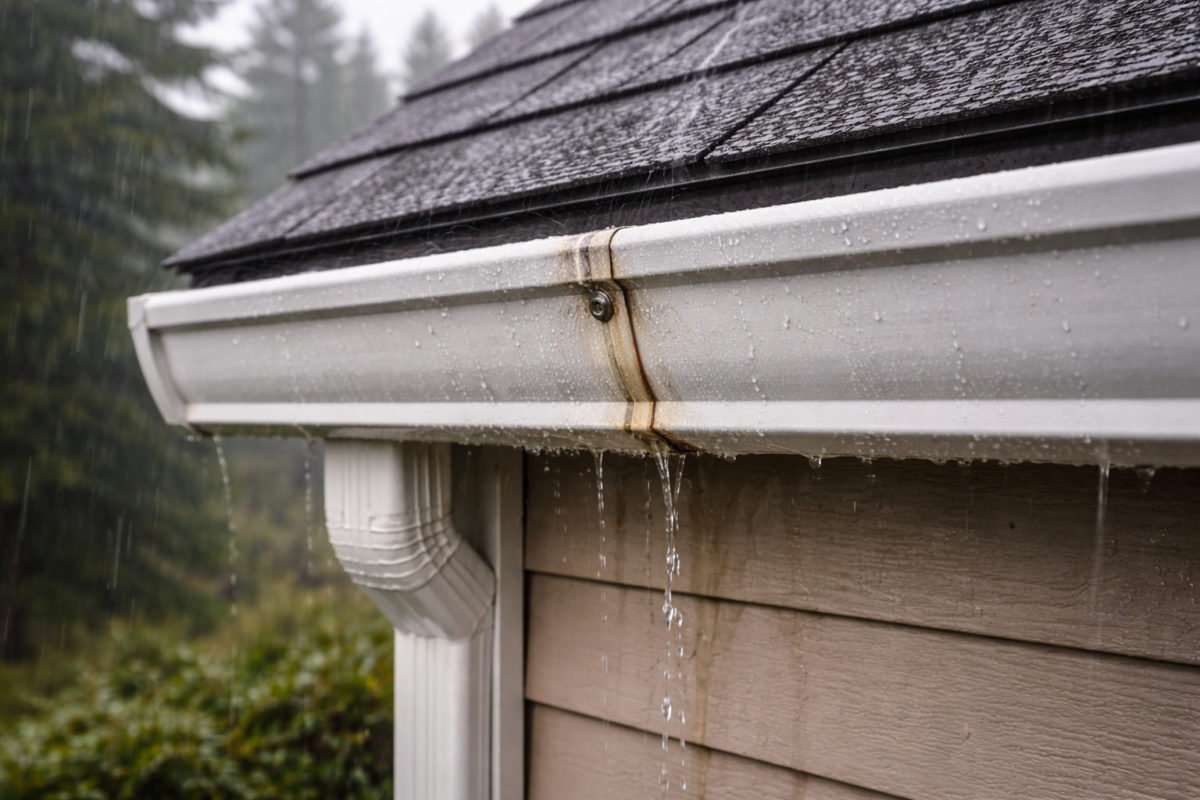
A brief shower might leave your gutters looking perfectly fine, but Oregon’s long, soaking storms often tell a different story once water has been running for hours. Those stretches of near-continuous rainfall push every part of a gutter system to perform without a break.
During these longer storms, small flaws like a thin seam gap, a tired bead of sealant, or a slightly sagging section suddenly become obvious. What looked minor during last week’s drizzle can turn into an active drip line during the next multi-day system. These storms act like a natural stress test, and the results usually point directly to areas that need gutter repair before the damage has a chance to spread.
This article looks at why Oregon’s extended rain cycles reveal these hidden weaknesses, how the leaks form, and why early attention is the simplest way to protect fascia, siding, and the foundation from deeper problems.
The Difference Between a Shower and a Soaking
Short bursts of rain rarely push a gutter system to its limits. A ten-minute shower does not carry enough volume or last long enough to show how well seams hold or whether the pitch is set correctly. The system gets wet, sheds water, and dries out. It is almost too quick to expose anything but the most obvious issues.
But Oregon rarely sticks to short bursts. A month like November 2025 in Portland, which brought 4.53 inches of rain along with 18 days of measurable precipitation, creates an entirely different scenario. Water moves through the gutters day after day, and the materials never get a chance to dry out. Small flaws that sat unnoticed for months suddenly become visible because the runoff keeps finding the same weak point repeatedly.
How Continuous Rain Exploits Specific Weak Points
When storms run for days, gutters experience constant pressure. The water keeps flowing, and anything that is even slightly out of alignment shows up far more dramatically. This is when rain gutter repair becomes protection from a storm cycle that does not ease up.
Failed Sealant at Seams
Sealant weakens gradually, and many homeowners do not notice when it begins to thin or crack. Continuous moisture from long storms keeps those areas wet, and that steady dampness creates the right conditions for small gaps to widen. What once looked like a harmless seam becomes the spot where water consistently slips through.
Loose Fasteners and Hangers
It does not take much movement to change how a gutter carries water. A fastener that has pulled out even slightly will create a slight sag, and that sag becomes more obvious when the gutters stay full for long stretches.
Water collects at the low point, and eventually it spills backward or over the front edge. The sag that did not matter during short storms suddenly causes overflow during extended rain.
Minor Pitch Flaws
Pitch problems are subtle. A section may hold a shallow puddle for days rather than draining fully, and that standing water makes nearby seams and end caps more vulnerable. Over several back-to-back storms, that tiny depression becomes a repeated overflow point, usually the moment a homeowner realizes something is off.
Aging Material Fatigue
Older systems reach a point where thin spots or pinholes give way simply because they never get to dry. Oregon’s long stretches of rain create exactly that environment. Water does not have to pour through. A slow but steady leak over three days can cause more damage to siding and fascia than one heavy downpour.
These patterns are becoming more familiar as atmospheric rivers intensify. Research shows that these systems have grown 2–6% more frequently and now cover 6–9% more area compared to earlier decades. Longer storms mean more chances for gutters to reveal the problems they have been carrying quietly.
The Consequences of Ignoring a “Small” Leak
A small drip during a long storm might seem manageable, but the danger lies in how repeatedly it hits the same part of the home. Water slipping behind a gutter can soak fascia boards long enough for the material to stay damp past the safe window.
EPA guidance notes that moisture lingering beyond 24–48 hours increases mold risk, and a multi-day storm easily exceeds that threshold. Once the fascia begins to soften, wind, pests, and additional storms speed up the deterioration.
The problem does not stay outside, either. Water that tracks the wrong way can slip behind siding or travel along framing, sometimes showing up indoors as staining or musty odors days later. Meanwhile, what could have been addressed with a straightforward gutter repair often climbs into the category of replacement or structural remediation.
Insurance data from recent years supports this trend, showing that water-related damage regularly generates costly claims. Even though these numbers are broad, they highlight a simple truth: Letting small leaks continue multiplies the repair bill.
The Proactive Defense: Inspection and Protection
The best time to evaluate gutter performance is after a long storm. When the system has been running steadily, weak seams leave visible drip marks, and fascia often shows slight discoloration where moisture is seeping through. A quick inspection during or right after a soaking storm can reveal what weeks of dry weather hide.
This is where a trained eye matters. A professional does not just identify the symptom. They look for the cause, like a hanger that has shifted, a section that lost its pitch, or an outlet that is pushing too much flow toward one seam. Fixing the root issue, rather than sealing the visible drip alone, is how you prevent the problem from returning during the next storm cycle.
Homeowners can also add protection by installing rain gutter guards, especially in areas where debris creates early-season clogs. Gutter guards keep leaves and roof grit from collecting, which reduces pooling behind clogs and lowers the pressure on seams.
Homeowners often want a clear sense of price before moving forward, and national figures help frame that decision. Current data shows gutter guard installation cost for professional work typically falls between $10 and $25 per linear foot, while DIY options sit closer to $4–$5.
Don’t Wait for the Next Forecast
In Oregon, gutters rarely get long breaks. What looks harmless between storms can turn into a steady leak as soon as the next multi-day system arrives. The safest approach is early detection. Every small fix you make now prevents larger repairs later, especially when the climate repeatedly tests the same weak spots.
If you want help protecting your home from wind and water damage, contact us here, call us at (971) 777-9899, or fill out this form here for a free estimate. Gutter Empire can identify the issues you cannot see, provide lasting gutter repair, and keep your home ready for Oregon’s toughest storms.
Key Takeaways
- Multi-day storms act as a natural stress test for gutter systems.
Extended rainfall keeps gutters wet for hours or days, revealing weak seams, aging sealant, and sagging sections that often go unnoticed during short showers. - Continuous moisture accelerates leak formation and structural damage.
Long storm cycles increase pooled water, widen seam gaps, and stress loose hangers — eventually leading to overflow, fascia softening, and water intrusion behind siding. - Leaks that persist for 24–48 hours significantly increase mold risk.
Slow drips and damp fascia boards can hold moisture beyond safe limits, creating ideal conditions for mold growth and hidden indoor damage. - Minor leaks during storms often indicate underlying slope or fastener failure.
The visible drip is typically a symptom — the real cause may be pitch loss, hanger movement, or an outlet channeling too much flow into one seam. - Early inspection after long storms prevents large repair costs later.
Addressing seam leaks, hanger shifts, and minor sagging now reduces the risk of fascia rot, siding damage, and future gutter replacement. - Gutter guards can reduce pooling and seam pressure in debris-heavy areas.
They help prevent clogs that worsen leak points during extended rainfall cycles.
Citations
- https://forecast.weather.gov/product.php?issuedby=PDX&product=CLM&site=BRO
- https://journals.ametsoc.org/view/journals/clim/38/6/JCLI-D-24-0234.1.xml
- https://www.epa.gov/mold/brief-guide-mold-moisture-and-your-home.