
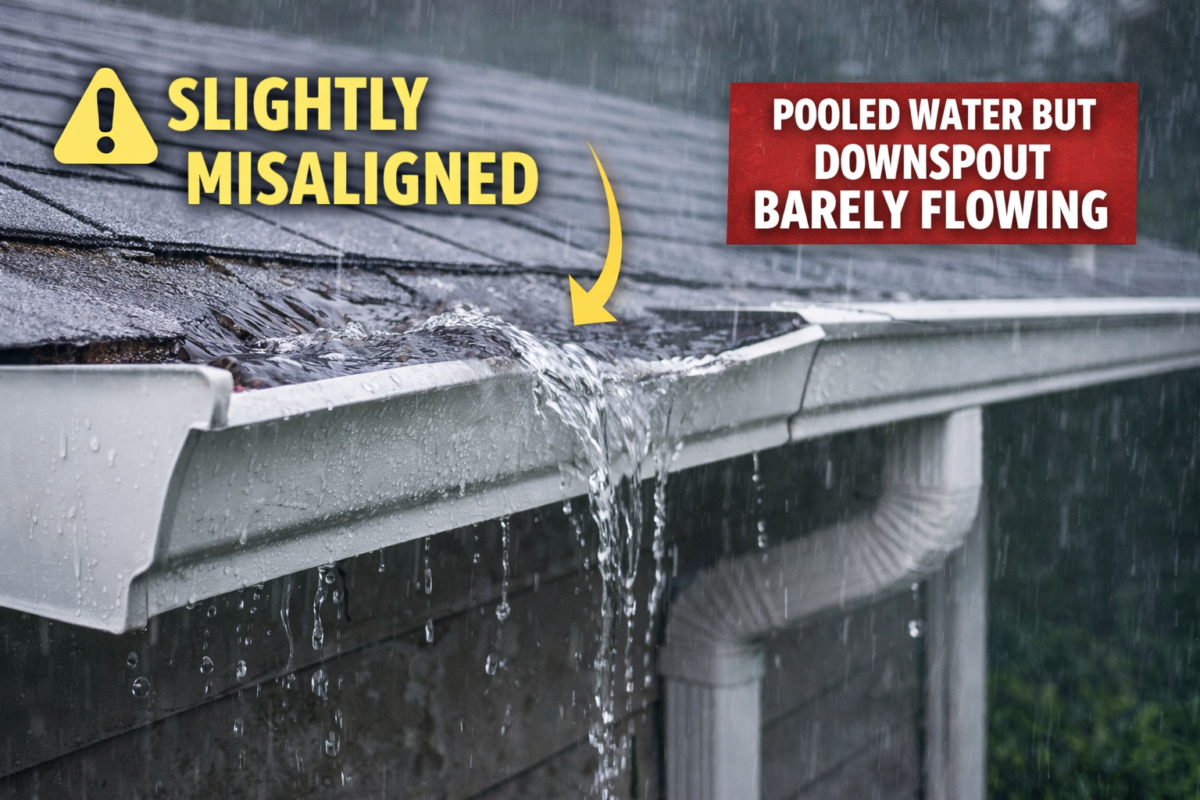
A gutter can look fine from the driveway, yet hide a tiny tilt that sends water in the wrong direction. In a place like Oregon, where rain falls in long stretches rather than quick bursts, even small alignment issues affect how rain gutters direct water off the roof.
Misalignment slows the downflow, encourages pooling, and eventually forces water over the edge rather than toward the downspouts. The result is a chain of damage that homeowners do not always connect back to the original problem.
Correcting pitch or realigning early through professional gutter repair usually solves the issue before it progresses into structural damage, especially when the underlying system is still solid from the initial gutter installation.
Quick Answer Summary
When rain gutters become slightly misaligned, water flow slows and begins pooling instead of moving toward the downspouts. In wet climates like Oregon and Washington, this pooling can lead to overflow, fascia rot, siding damage, and soil saturation around the foundation. Even small pitch issues can disrupt drainage because gutters rely on precise slope to guide water away from the roof and structure. Early gutter repair or realignment can restore proper flow and prevent more costly structural damage.
The Science of Proper Alignment
A well-aligned gutter looks simple, but it follows rules that help water move reliably. Gutters need a steady pitch, typically around ¼ inch per 10 feet, so gravity can guide water toward the downspouts. Gutters should maintain at least 1/16 inch of slope per foot. When installers drift from that standard, even slightly, you end up with dips or raised spots that change how the system performs.
From the ground, “slightly misaligned” might look like a subtle sag in the middle of the run or a corner that appears tilted. Sometimes there is a faint gap between the gutter and the fascia because a hanger has loosened. These look harmless at first, but in Oregon’s climate, they rarely stay harmless. Constant rainfall means the system never gets a break, as water tests every weak point day after day.
How Water Behavior Changes
A misaligned section slows the flow almost instantly. Water loses momentum when it hits a dip or high point, and debris begins to settle in those slower-moving areas. That extra layer of leaves or grit becomes the start of a clog, which only worsens during the next storm. If water cannot move fast enough, the whole length of the gutter works harder than it should.
Once flow slows, pooling follows. Low spots catch water rather than send it down the line. Over time, that standing water adds weight that stresses the hangers and pulls the gutter farther out of position. Moisture also lingers more than it should. Wood begins to decay once the moisture content exceeds roughly 20 percent. A gutter that traps water near the fascia increases that exposure every day it rains.
When the next storm arrives, often sooner than expected in Oregon, pooled water combines with new rainfall. The gutter simply cannot keep up. Overflow happens in the exact spot where the pitch failed, and downspouts sometimes remain underused because water never reaches them. Downspouts should carry water away at least five feet from the home, or ten feet if routed into underground drains. Misalignment stops that from happening, so even a properly placed downspout becomes ineffective.
The Damage Chain Reaction
Overflow may seem minor in the moment, but repeated exposure sets off a predictable chain of problems.
Fascia Board Rot
Once water spills behind the gutter, the fascia absorbs it repeatedly. Oregon’s wet months rarely give wood enough time to dry out between storms. Over time, rot creeps in. It can spread behind the gutter run and remain unnoticed until the board weakens enough for the gutter to pull forward. Properly sloped gutters are crucial for preventing this kind of deterioration.
Siding Stains and Deterioration
Water that pours over the front edge streaks down the siding. Minerals in rainwater leave marks, and moisture creates a surface where mold can take hold. Mold usually does not grow when wet areas dry within 24–48 hours. Oregon’s climate often removes that window, so even small overflow points can create persistent discoloration or staining.
Concentrated Ground Saturation
When misalignment pushes all the runoff into one spot, the ground absorbs more water than it can handle. Soil erodes or begins to sink, and low areas start to hold puddles. Drainage should be away from the foundation because pooling near the perimeter increases the risk of seepage into crawlspaces or basements.
Structural Risk
Long-term saturation changes soil behavior. It settles differently, especially when storms repeat over weeks.
Reed College’s report on Oregon flood insurance trends found that more than 27 percent of NFIP claims from 1978 to 2024 occurred outside mapped floodplains. That surprises homeowners, but it reflects a common pattern: Water rarely stays where you assume it will. A small misalignment in rain gutters can contribute to that unexpected concentration of moisture along the foundation line.
Visual Signs Your Gutters Are Misaligned
- Waterfalls Between Downspouts: During a storm, water might pour over the gutter in one specific place even though the downspout nearby is barely moving. That usually points toward lost pitch or a developing low spot.
- Standing Water: If you check the gutter after rainfall stops and see a puddle sitting in the middle, alignment is off. A properly pitched gutter drains completely.
- Gap Visibility: When daylight shows between the gutter and the fascia, hangers may have loosened, or wood behind the gutter may have softened. Both create conditions for misalignment.
- Staining Patterns: Staining patterns often show up as dark streaks on the siding below a misaligned section. They build gradually, marking the exact spot where overflow repeatedly hits.
When Repair Suffices vs. When Replacement Is Needed
Most small alignment issues can be fixed rather than replaced, especially when the gutter is still solid and only slipped a bit. A tech can reset the slope, tighten loose hangers, or add support where the run has started to dip. They may also change downspout spacing so the system keeps up during heavier rain. Learning to repair gutters early prevents minor issues from becoming structural problems.
Replacement becomes necessary when the fascia is too damaged to hold anchors or when the original gutter installation created a structural problem that cannot be corrected by simply adjusting the pitch. Multiple failing sections, widespread rot, or a system installed without proper slope often require a new setup rather than a patch.
Realign Your Home’s First Line of Defense
A misaligned gutter may not seem urgent, but in a rainy climate, it always catches up to the house. Small shifts change how water moves, and once that movement becomes unpredictable, the system stops doing its job. Overflow, staining, soggy fascia, and ground saturation all start from the same point: water that was supposed to travel toward the downspout but never made it.
Addressing the issue early through professional gutter repair protects the home and often saves the system from needing full replacement. When the structure is still in good shape, skilled gutter repairs bring everything back into alignment.
Let Gutter Empire get your system working the way it should. Contact us at (971) 777-9899, click here for a free estimate, or use our contact form to schedule your professional gutter repair and inspection today.
Key Takeaways
- Rain gutters must maintain a consistent slope (commonly about ¼ inch per 10 feet) to allow gravity to move water efficiently toward downspouts.¹
- Even small dips or raised sections can slow water flow, allowing debris buildup and standing water to form.
- Standing water increases the load on gutter hangers and exposes fascia boards to prolonged moisture, which can accelerate wood decay when moisture levels exceed roughly 20 percent.²
- Misalignment can cause localized overflow, leading to siding staining, mold growth, and concentrated soil saturation near the foundation.
- Poor drainage increases the risk of foundation moisture problems and unexpected flooding patterns. Research has found that over 27% of National Flood Insurance Program claims occurred outside mapped floodplains, showing how water often accumulates where homeowners do not expect it.³
- Early gutter repair—such as resetting pitch or tightening hangers—can often correct misalignment before structural damage develops.
- Replacement is usually only necessary when fascia boards are severely damaged or the original gutter installation lacks proper slope.
Citations
- Pacific Northwest National Laboratory – Proper gutter slope and drainage guidance
https://basc.pnnl.gov/resource-guides/gutters-and-downspouts - USDA Forest Service – Moisture thresholds and wood decay behavior
https://research.fs.usda.gov/treesearch/8587 - Reed College – Flood insurance trends and unexpected flood risk data
https://www.reed.edu/newsroom/press-releases/2025/navigating-rising-waters-report-highlights-concerning-decline-in-flood-insurance-coverage-across-oregon.html