
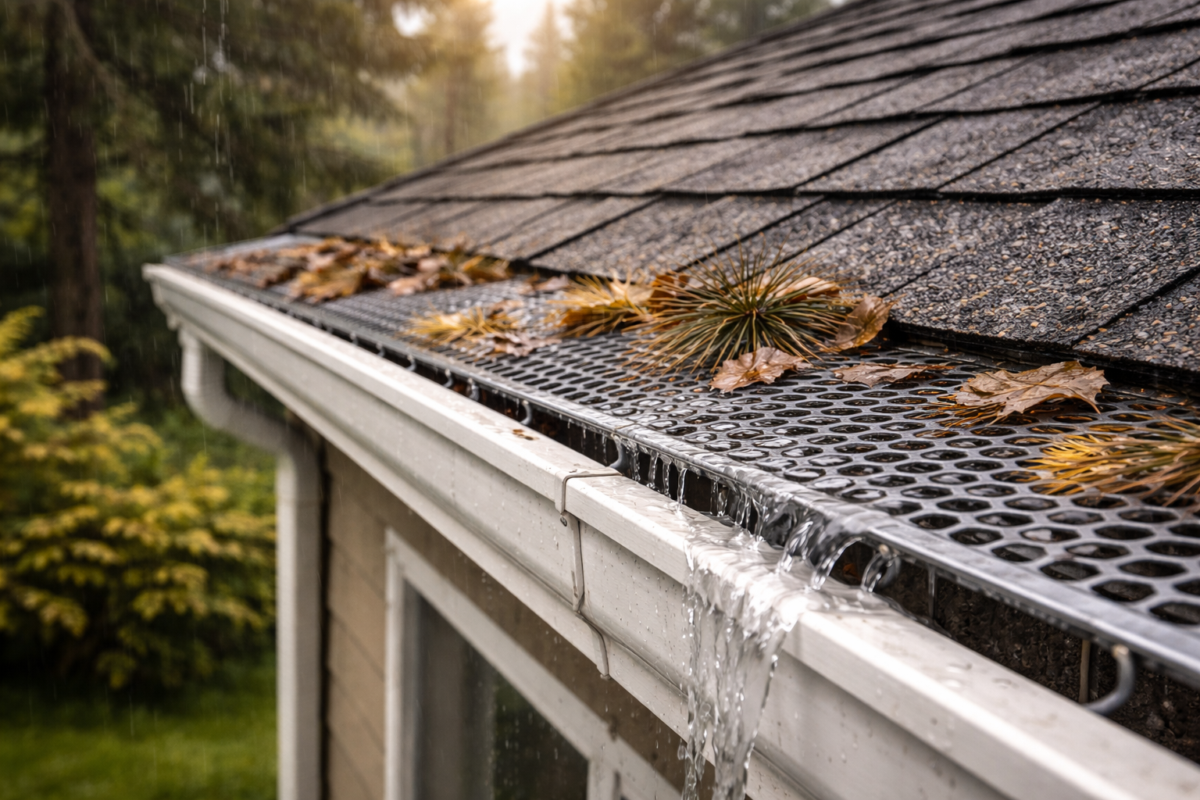
Every Oregon homeowner knows the routine. You book gutter cleaning in the spring. Then again, in late fall. Maybe once more if the fir needles really pile up. It feels manageable at first, until you step back and realize you have been paying for the same service every year. That is where installing gutter guards can make a huge difference.
A proper gutter guard installation does require an upfront investment. Still, it shifts how you spend money on your home’s drainage system over time. Instead of budgeting for recurring cleanings, you begin to focus on protection and reduced maintenance. When you carefully compare the long-term numbers, the cost equation looks different from what most people expect.
Quick Answer Summary
Installing gutter guards reduces long-term gutter cleaning costs by lowering how often full cleanings are needed. While guards require an upfront investment, most homeowners break even after several years by avoiding repeated service visits. In high-debris areas like Oregon, where gutters may need cleaning multiple times per year, guards can significantly cut lifetime maintenance expenses and help prevent water-related damage.
Annual Gutter Cleaning Costs Without Guards
Let’s start with the standard rhythm most Oregon homes follow. Industry guidance commonly recommends professional gutter cleaning at least twice a year. In a place like Portland, where 2024 rainfall reached 39.67 inches, above the historical norm, staying ahead of buildup matters. Wet seasons amplify small clogs into real overflow.
Nationally, the average gutter cleaning cost is about $168 per visit, with a typical range of $119 to $234. Many homes have between 125 and 200 linear feet of gutter, and some contractors price by the foot, roughly $0.95 to $2.25 per linear foot. Those numbers sound reasonable in isolation.
But multiply them.
At two cleanings per year, the average homeowner spends about $336. Over five years, that adds up to $1,680. Over ten years, $3,360. Stretch that to twenty years, and you are looking at $6,720, just for clearing debris. That assumes you only need two visits per year.
Tree density changes the math quickly. Homes surrounded by pines, firs, or mature maples often need a third visit. Heavy debris loads are common in many Oregon neighborhoods, especially near wooded lots. In those cases, the yearly expense rises before you even think about inflation or storm-related emergency cleanouts.
Small problems also compound quietly. Minor issues like resealing joints or re-hanging loose sections cost far less than replacement. But when clogged gutters overflow repeatedly, fascia boards soften, brackets loosen, and seams separate. At some point, those “just clean them again” cycles turn into structural deterioration.
The Post-Installation Shift: Dramatically Reduced Cleaning Frequency
A well-executed gutter guard installation does not eliminate maintenance entirely. But it reduces the frequency of intensive, scoop-and-flush service.
Instead of paying for two or three full cleanings per year, many protected systems require only occasional inspection and light clearing. The debris sits on the guard surface rather than compacting within the trough. That difference matters because packed, waterlogged debris accelerates corrosion and joint failure.
Think of it this way. Without guards, you remove decomposing leaves from inside the channel multiple times per year. With guards, you remove surface debris periodically. It is a different level of labor.
The financial shift shows up gradually. Fewer service visits mean lower lifetime spending. Less standing debris means less strain on seams and hangers. Minor fixes, like resealing corners or tightening brackets, remain minor because water flows as designed.
The Long-Term Financial Comparison
Let’s compare the two paths directly.
Scenario A, No Guards
Assume two professional cleanings per year at the national average of $168. Ten years equals about $3,360. Twenty years approaches $6,720. If inflation stays modest, service costs will likely rise over time. For context, consumer prices increased 2.4% over the 12 months ending January 2026.
Scenario B, With Guards
You invest once. Using the national average, that investment might be around $1,517. Larger homes cost more, but even then, you convert recurring expenses into a contained, predictable one. You still plan for light inspections, but you eliminate many of the repeated labor visits.
The break-even point depends on how often you currently pay for cleaning. If your home needs three visits per year, you reach parity much faster than a home that needs only one. Using average pricing, roughly nine standard cleanings equal a $1,517 installation. In high-debris environments, that threshold can arrive sooner than homeowners expect.
There is another angle people forget. Water damage claims remain common nationally. Industry data shows that about 1 in 67 insured homes experiences water-related property damage. While not all water damage starts at the roofline, overflow certainly increases risk. When gutters fail, repairs escalate quickly, from fascia rot to foundation saturation.
When It Makes the Most Sense to Install Gutter Guards
Heavy Tree Coverage
If your roofline sits under tall trees, the math usually shifts in your favor. Leaves and needles collect faster, which often turns a “twice-a-year” routine into extra cleanings. In Oregon, steady rain makes clogs show up quickly as overflow, not weeks later. Cutting down the buildup means you pay for fewer visits, and your gutters spend more time doing what they are supposed to do.
Planned Long-Term Ownership
If you plan to stay in your home for ten years or longer, the cumulative savings become easier to justify. The longer you avoid recurring gutter-cleaning costs, the more the numbers tilt in favor of protection.
Aging or Mobility Concerns
Climbing ladders in wet conditions is not trivial. Even if you hire professionals, reducing visits lowers scheduling stress and exposure to safety risks. That benefit goes beyond dollars.
Combined With New Gutters
Pairing gutter guard installation with new seamless gutters maximizes efficiency. If your existing system already shows signs of sagging, joint failure, or repeated overflow damage, combining upgrades can help you avoid paying twice.
Make the Numbers Work for Your Roof and Trees
Tree canopy, roof design, linear footage, and local labor rates are among the factors that determine whether installing gutter guards delivers quick savings or long-term stability.
The key is to compare lifetime totals. Look at what you currently spend on gutter cleaning over ten or twenty years. Compare that to the realistic gutter guard installation costs for your home. Then factor in reduced wear, fewer emergency visits, and better water control during heavy rain seasons.
If you want a grounded assessment instead of guesswork, we can help. At Gutter Empire, we look at your specific roofline, debris load, and maintenance history to calculate real savings. Contact us at (971) 777-9899, click here for a free estimate, or schedule a consultation online. We will walk you through how installing gutter guards can reshape your long-term maintenance costs and help you protect your home without overpaying year after year.
Key Takeaways
- Gutter cleaning typically costs $119–$234 per visit, averaging about $168, and many homes need two or more cleanings per year.¹
- Over 10–20 years, recurring cleanings can cost $3,360 to $6,720, not including inflation.²
- Installing gutter guards converts ongoing maintenance costs into a one-time investment with only light periodic inspections.
- Homes surrounded by trees reach the break-even point faster because they require more frequent cleanings.
- Consumer prices rose 2.4% year-over-year, meaning service costs are likely to increase over time.²
- About 1 in 67 insured homes files a water-damage claim annually, and clogged gutters can contribute to overflow-related issues.³
- Gutter guards help maintain proper water flow, reducing strain on seams, fascia, and hangers and lowering the risk of structural deterioration.
- Long-term homeowners see the greatest financial benefit, especially when guards are installed with new seamless gutters.
Citations
- National Weather Service – Portland rainfall and climate data
https://forecast.weather.gov/product.php?format=CI&glossary=1&issuedby=PDX&product=CLA&site=IWX&version=4 - U.S. Bureau of Labor Statistics – Consumer Price Index (inflation data)
https://www.bls.gov/news.release/cpi.nr0.htm - Insurance Information Institute – Water damage claim frequency
https://www.iii.org/fact-statistic/facts-statistics-homeowners-and-renters-insurance