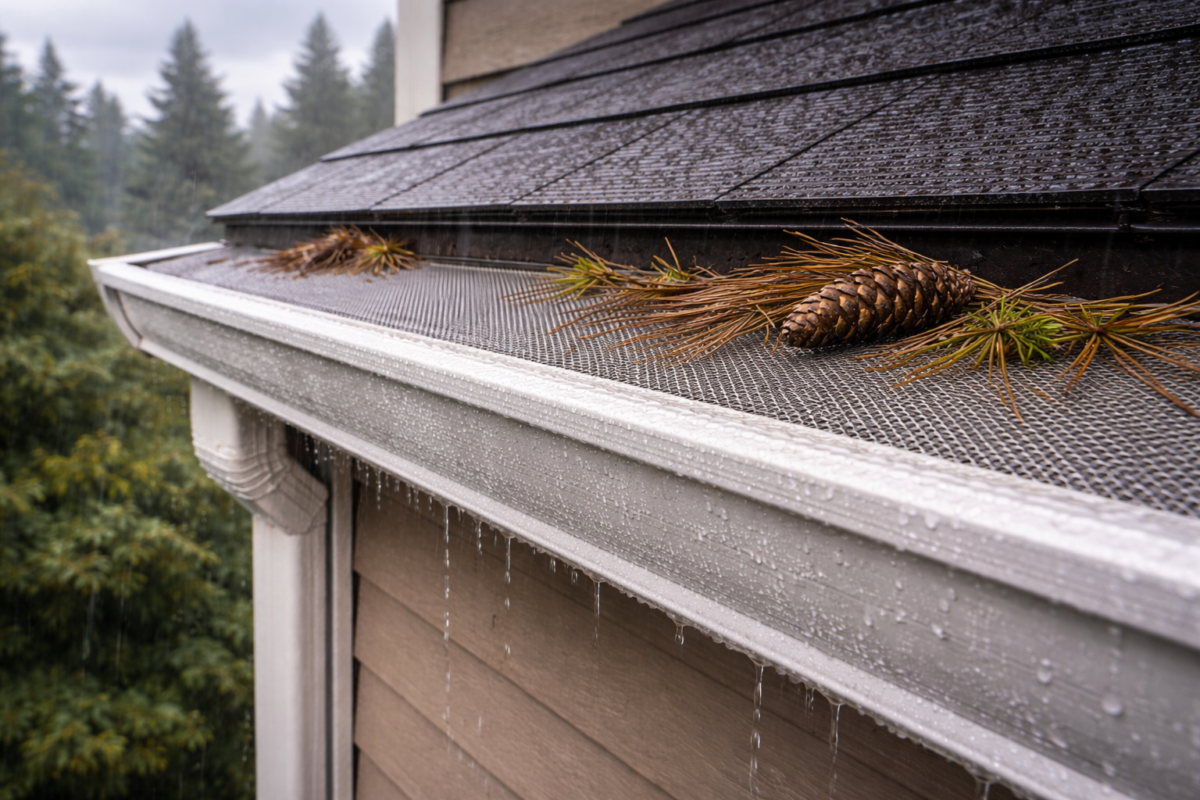
Oregon homeowners often move through fall and winter feeling like their gutters are always one storm away from trouble. Pine needles drift down almost constantly, maple leaves arrive in waves, and long stretches of rain keep everything soaked. That combination makes people wonder whether gutter guards can finally slow the cycle of clogging and overflow.
The short answer is that they help, sometimes dramatically, but they work best when the system matches local debris, and the installation is done with care. Once gutters stay wet for days at a time, seam sealants soften, small gaps widen, and even clean gutters can start leaking.
This article examines how gutter screens and other styles perform in Oregon, how they handle heavy water flow, and what homeowners should expect when they choose gutter guard installation as part of their maintenance plan.
What Are Gutter Guards?
A helpful way to think about gutter guards is that they create a filtered entry point. Water still needs to enter the gutter freely, but leaves, needles, and roof grit should stay out.
Gutter screens fall into this category, but they are just one type. Micro-mesh, reverse-curve, and insert-style designs all fall under the broader umbrella. Whatever the design, the goal is simple: reduce the debris load so gutters stay clear long enough to move rainfall away from the house. FEMA’s home protection guidance makes that core idea clear: Roof runoff must drain efficiently to avoid moisture near fascia, siding, and foundations.
According to the Insurance Information Institute, water damage remains one of the most expensive categories of home insurance claims, averaging 1.50 claims per 100 house-years and roughly $15,400 in severity. When gutters clog or overflow along the back edge, that risk increases quickly.
How Effective Are Gutter Guards in Oregon?
Do gutter guards work? Yes, they do, but their success depends on matching the right type to your specific debris (pine needles vs. maple leaves). The biggest split happens between broadleaf debris and the thin needles dropped by fir and hemlock. Some screens block leaves well but allow needles to stack on top.
A major U.S. university’s 2024 construction spec even states that gutter protection should “preclude pine needles” when trees are nearby, which says a lot about how demanding this debris can be. When guards match the debris, homeowners usually see fewer clogs and noticeably fewer mid-season cleanouts. When they do not match, the buildup shifts from inside the gutter to the guard surface, further slowing drainage.
Handling Heavy Rain
Rainfall volume shapes everything in Oregon. NOAA reports 41 major weather and climate disasters affecting the state from 1980 to 2024, and the last five years average more than double the long-term annual event rate. That pattern shows how easily rain can move from steady to overwhelming.
Any gutter guard installation must be pitched and fitted so water hugs the guard surface and drops into the gutter rather than shooting past the edge. When a guard works with the roofline, stormwater overflow drops sharply. When it does not, rain simply bypasses the entire system.
The Moss Factor
Moss fragments behave like wet dust. They drift, settle, and cling to screens. Gutter guards help reduce the risk of large clogs, but fine grit still accumulates slowly.
Even improved systems need periodic checks. Oregon homeowners see this most clearly along shaded roof sections where moss is persistent. Guards reduce the worst clogs, but no design eliminates the need for occasional rinsing.
Types of Guards: Which Is Right for Oregon Debris?
Choosing a system often matters more than choosing a brand. Oregon debris comes in shapes and textures that interact differently with each guard style.
Mesh Screens
Screens handle maple leaves and ash leaves well, but the openings that allow water to pass also let needles stack or weave through. In needle-heavy neighborhoods, screens help but do not solve the full problem.
Micro-Mesh Guards
Micro-mesh systems block almost everything except water. That needle-focused design aligns with the construction guidance, which recommends products that “preclude pine needles.” Homeowners near large evergreens usually find this to be the most dependable option.
Reverse Curve/Surface Tension
These systems rely on water adhesion to pull rain into the gutter. They can handle storms well, but clingy, rain-soaked leaves sometimes bridge over the opening. In Oregon, that effect is most evident during back-to-back storms, when debris stays wet for days.
Brush & Foam Inserts
Insert-style guards sit directly inside the gutter channel. In dry regions, that might work, but in Oregon, they tend to hold moisture, trap grit, and accelerate sludge buildup. They also make cleaning more awkward.
The Pros and Cons for Oregon Homeowners
Most Oregon homeowners notice the advantages of gutter screens and other systems almost immediately. Fewer clogs mean fewer times up a ladder and fewer overflow streaks along the fascia. Reduced debris also slows rust and corrosion inside metal gutters. These small gains add up over time, especially across seasons where rain never fully lets up.
There are trade-offs, though. No gutter guard installation eliminates all maintenance, because fine grit and moss still find their way into the system.
Upfront costs also matter. The long-term savings come from reduced cleaning frequency and fewer overflow problems, not instant results. Poor DIY installation can make things worse, as incorrect pitch or loose fasteners can cause water to overflow entirely.
Making the Decision: Is Gutter Guard Installation Right for You?
Homes surrounded by trees see the biggest payoff. Needle-heavy areas especially benefit from gutter screen installation because the debris pressure stays constant. Homeowners who want fewer ladder climbs or who have dealt with repeat clogs often notice immediate improvement.
The key variable is installation. Pitch, placement, material choice, and roof-edge geometry all determine how well gutter guard installation performs during Oregon’s long, soaking storms.
If guards are not the right match, a scheduled cleaning plan still protects gutter seams from staying saturated long enough to fail. Rainfall that lingers on a seam weakens the sealant, and once a gap opens even a little, overflow follows the path of least resistance, usually toward fascia or siding.
Take Control of Your Gutter Maintenance
Oregon’s never-ending rain makes gutter care feel like a moving target, but gutter guards give homeowners a way to get ahead of the cycle. They slow debris buildup, reduce the stress on gutter seams, and keep water moving the way it should during long stretches of storms. They are not perfect, and they still need quick check-ups, but the right match between product and debris can make gutters far more dependable. If you want help choosing a system that fits your home and climate, contact us at (971) 777-9899 for a professional assessment, or click here for a free estimate.
Key Takeaways
- Gutter guards can significantly reduce clogging in Oregon, but performance depends on matching the guard type to local debris such as pine needles, leaves, and moss. Improper matches can shift buildup to the guard surface rather than eliminating it.¹
- Micro-mesh gutter guards are often the most effective option for Oregon homes, especially in evergreen-heavy areas, because they are designed to block fine debris like pine needles that commonly defeat standard screens.²
- Heavy and prolonged rainfall increases the consequences of clogged or overflowing gutters, contributing to water intrusion near fascia, siding, and foundations—areas frequently linked to costly homeowner insurance claims.³
- No gutter guard system is maintenance-free, particularly in damp, shaded environments where moss and fine grit persist. Periodic inspection and light cleaning are still necessary to maintain proper drainage performance.¹
- Professional installation is critical in Oregon’s wet climate, as incorrect pitch, loose fasteners, or poor roof-edge alignment can cause rainwater to overshoot guards entirely during major storm events.³
Citations
- Insurance Information Institute – Facts & Statistics: Homeowners and Renters Insurance
https://www.iii.org/fact-statistic/facts-statistics-homeowners-and-renters-insurance - University of Florida IFAS Extension – Residential Construction Specifications (2024)
https://pdc.ufl.edu/wp-content/uploads/2025/03/dcs-10-075000-rev-031424.pdf - NOAA National Centers for Environmental Information – U.S. Billion-Dollar Weather and Climate Disasters
https://www.ncei.noaa.gov/access/billions/