
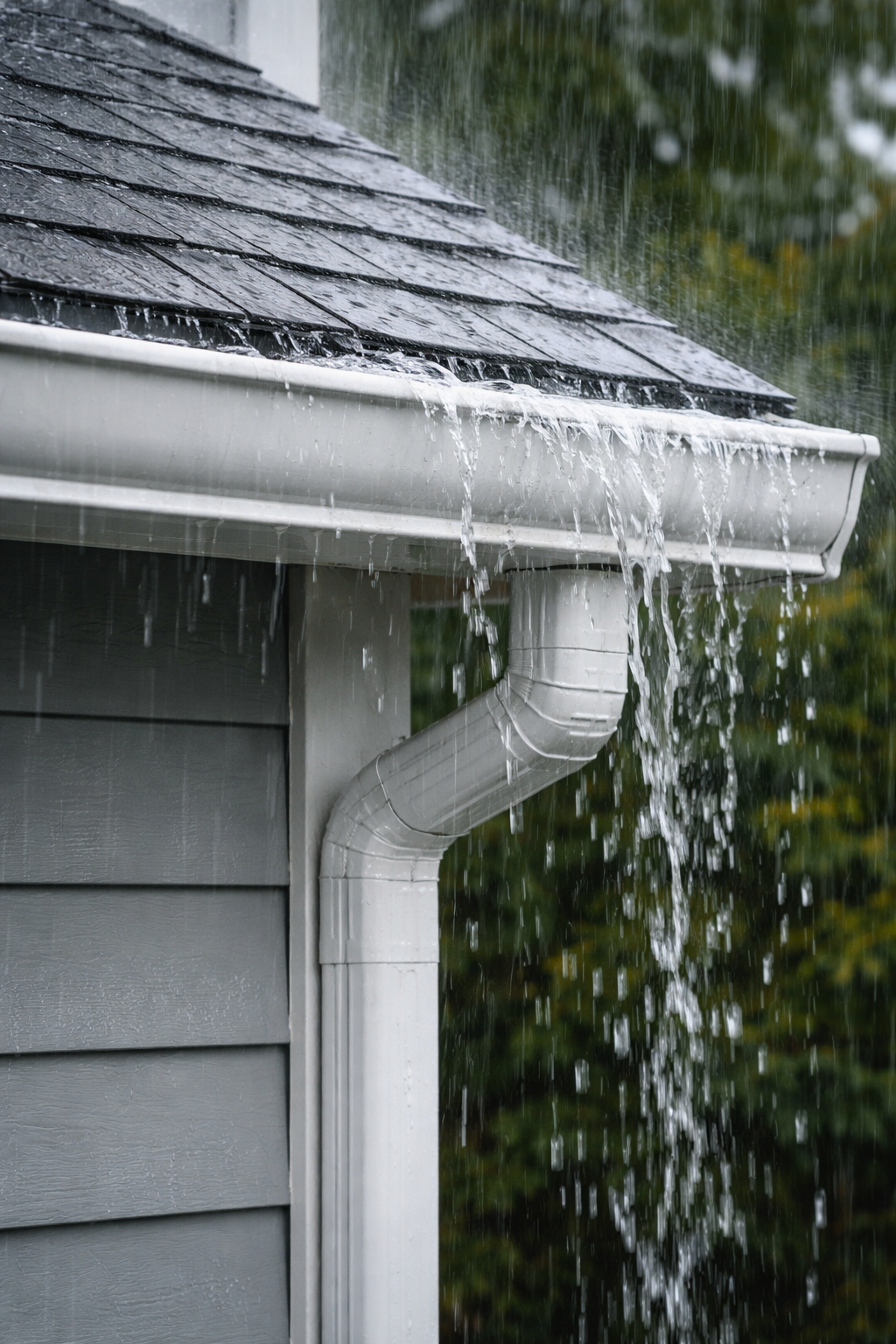
You paid for new gutters. The crew came, did the work, and cleaned up. And then Oregon’s wet season arrived, and water was spilling over the sides again, as if nothing had changed. That’s a frustrating situation, and it raises a legitimate question: If the gutter installation is new, why is this still happening?
The short answer is that new gutters don’t automatically mean a well-functioning system. Overflow after a recent installation is more common than most homeowners expect, and if it’s left alone, the consequences can spread through your home in stages, starting outside and working inward. Understanding what’s happening and why is what gets you to the right fix.
Quick Answer Summary
Rainwater can overflow even after a recent gutter installation when the system is improperly sized, incorrectly pitched, poorly designed, or partially clogged. In rainy regions like Oregon, sustained rainfall exposes these issues quickly. Overflow leads to concentrated water near the foundation, fascia damage, and long-term structural risks. Fixing the root cause—whether it’s sizing, slope, or downspout layout—is essential to restoring proper drainage.
What Happens Immediately: Water Finds the Path of Least Resistance
The moment gutters overflow, water concentrates at specific low points, usually right along your foundation. Oregon’s rainfall pattern makes this especially problematic. Nearly 90% of Portland’s annual rainfall lands between mid-October and mid-April, so when overloaded gutters spill, they’re doing it repeatedly, in the same spots, for months at a time.
Saturated soil against foundation walls doesn’t just sit there. It starts exerting hydrostatic pressure, that steady push of water-logged earth against concrete or block. That’s when seepage and wall cracking become real possibilities. All of this from a gutter system that’s technically brand new.
What Happens in Weeks: Visible and Hidden Deterioration
Look behind the gutter where water is dripping. That’s your fascia board, and it’s absorbing moisture every time overflow occurs. Wooden fascia can develop soft spots within a single wet season, and once rot sets in, it doesn’t stop on its own.
Meanwhile, water sheeting down the side of the house leaves mineral streaks on the siding. Persistent moisture opens the door to mold, mildew, and paint failure. Around the landscaping, concentrated overflow carves gullies in flower beds, washes away mulch, and can start destabilizing walkways or patios over time.
None of this is catastrophic in week three. But it’s not cosmetic either. It’s the setup for what comes next.
What Happens Over Months: Structural Consequences
Prolonged soil erosion and uneven moisture around the foundation can cause settling and cracking. Doors start sticking, floors become uneven, and cracks appear in interior walls, seemingly unrelated to the gutters outside.
Eventually, moisture finds its way into basements and crawlspaces, damp conditions that invite mold and can compromise stored items and mechanical systems. And there’s a secondary problem that often goes unnoticed: Standing water inside the gutter itself adds weight. That weight pulls gutters loose, stresses seams, and accelerates wear on a system that should still have years of life ahead. That’s how new gutters end up needing early gutter repair.
For context, the Insurance Information Institute reports that water damage and freezing claims averaged $15,400 in severity between 2019 and 2023. Recurring overflow isn’t a minor inconvenience; it’s a structural risk with real costs.
Why New Gutters Still Overflow
This is the part most homeowners don’t get a straight answer on. There are a few distinct reasons a recently installed system can still fail.
Sizing Problems
It takes roughly 96 square feet of roof area to produce 1 gallon per minute of runoff under 1 inch of rain per hour. If the installer sized the gutters for a lighter load than your roof generates, or didn’t account for Oregon’s peak-intensity storms, the system will overflow even in its first season. NOAA’s Precipitation Frequency Data Server provides site-specific intensity data for exactly this reason, but not every contractor uses it.
Improper Pitch
Building America guidelines recommend at least 1/16 inch of slope per foot of gutter run so water moves steadily toward the downspouts. A system installed too flat or tilted slightly in the wrong direction creates standing water that eventually spills over the front edge. This is an installation error, and it can happen on a rain gutter installation that’s only weeks old.
Downspout Layout Issues
The standard recommendation is a downspout every 20 to 50 feet. If the installer reused an old layout with too few outlets or missed a high-volume roof valley, certain sections will overwhelm before others even start to fill. Sometimes what looks like a gutter problem is actually a discharge problem; downspouts terminating too close to the house, backing up, and causing pooling that looks like overflow from above.
Debris Buildup
Portland’s city guidance recommends cleaning gutters at least twice a year, more often if trees overhang the roof. Debris near elbows and downspout openings is a known culprit that can clog a new system within one fall season. Even seamless gutters, which reduce leak-prone joints, still accumulate debris near corners and outlets.
Repair vs. Replacement
Not every overflow situation requires starting over. Gutter repair makes sense when the problem is localized, such as a pitch correction here, an added downspout there, a cleared elbow, or a loose bracket that needs reseating. If the gutters are correctly sized overall and the issue is clearly contained, a targeted fix is usually the right move.
Gutter replacement becomes the better answer when the problems are systemic. An undersized system won’t perform adequately, no matter how many times individual sections are adjusted. Widespread fascia rot means there’s compromised wood where the gutters hang, which changes the scope of any repair. And if sectional gutters repeatedly fail at seams, a seamless system may be the smarter long-term investment because the core weakness is built into the product.
A professional inspection is what separates a reasonable repair from patching that only delays the same problem from returning next winter.
Stop the Cascade Before It Worsens
Overflow from new gutters is a warning. It doesn’t mean everything has failed, but it does mean something in the system isn’t keeping up with the actual demands your roof and Oregon’s rainfall are placing on it. The damage it causes moves slowly at first, then compounds: soil saturation, fascia decay, foundation stress, and moisture intrusion. Catching it early keeps those consequences manageable.
We at Gutter Empire are here to help you figure out exactly what’s going on, whether that’s a targeted gutter repair or a full gutter replacement properly sized for your home. Call us at (971) 777-9899, click here for a free estimate, or reach out through our contact form to schedule an inspection. We serve Portland, Gresham, Beaverton, and the surrounding Oregon communities.
Key Takeaways
- New gutters can still overflow if they are undersized for roof area or rainfall intensity, especially in regions with prolonged wet seasons.¹
- Nearly 90% of Portland’s annual rainfall occurs between mid-October and mid-April, placing sustained pressure on drainage systems.¹
- Improper pitch (less than ~1/16 inch per foot) can cause standing water and overflow, even in newly installed systems.⁴
- Downspout placement is critical; insufficient outlets or poor positioning can cause localized overflow even when gutters are properly sized.
- Debris buildup can clog a new system quickly, particularly in areas with heavy tree coverage, requiring regular maintenance even after installation.⁴
- Overflow leads to soil saturation, hydrostatic pressure, fascia rot, siding damage, and potential foundation issues.
- Water damage is costly, with claims averaging about $15,400 in severity, reinforcing the importance of proper drainage system performance.²
- Engineers use NOAA rainfall data to size systems correctly; ignoring this data increases the risk of early system failure during heavy storms.³
Citations
- National Weather Service – Portland Climate Data https://www.weather.gov/media/pqr/climate/ClimateBookPortland/pg1.pdf
- Insurance Information Institute – Water damage claim statistics https://www.iii.org/fact-statistic/facts-statistics-homeowners-and-renters-insurance
- NOAA Atlas 14 – Precipitation Frequency Data Server https://hdsc.nws.noaa.gov/pfds/
- Pacific Northwest National Laboratory – Gutter slope and drainage guidance https://basc.pnnl.gov/resource-guides/gutters-and-downspouts