
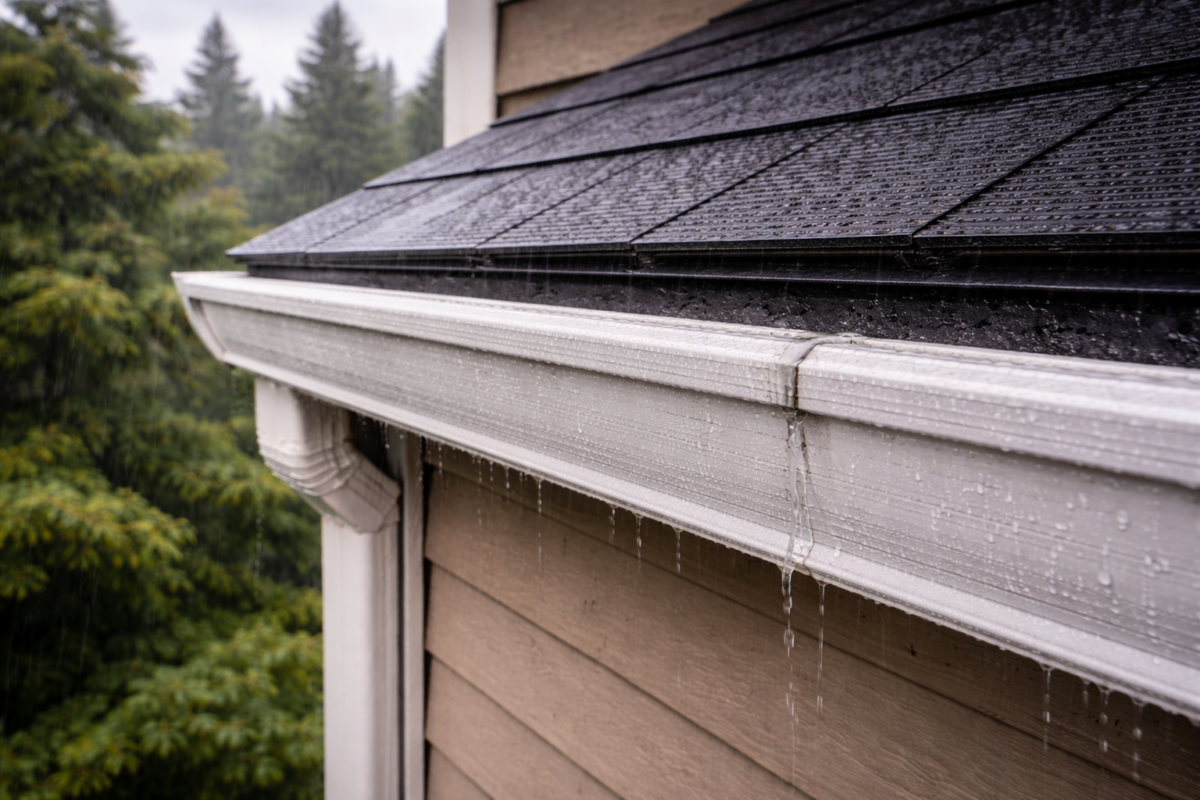
That annoying drip you hear during an Oregon drizzle rarely comes from the middle of a gutter run. It usually starts at a weak spot where pieces connect, shift, and slowly stop sealing the way they should.
Joint and seam failure is one of the most common reasons homeowners need rain gutter repair. It tends to get worse in quiet, predictable ways.
In this guide, we will walk through why these connections fail, how to spot the early signals, and what a professional fix looks like when you want the repair to hold through the next storm.
AI Overview Summary
Joint and seam failures are the most common cause of gutter leaks in Oregon homes. Unlike short storms, Oregon’s long rain cycles keep gutters wet for days, preventing sealants from curing and accelerating breakdown at corners, joints, and end caps. Repeated thermal expansion, debris buildup, and sustained water pressure during atmospheric river events turn small gaps into active leaks. Early professional gutter repair that addresses both the failed connection and the underlying drainage stress can prevent widespread system damage.
Oregon’s Climate: An Accelerant for Failure
Oregon weather does not just reveal joint problems. It speeds them up, especially when moisture and debris hang around long enough to keep stressing the same connection points.
Constant Moisture
When seams stay damp for days, small gaps do not get a break. Old sealants can soften, lift, or crack as water seeps into the tiniest cracks. Water does not only move by gravity; it also travels through capillary action, surface tension, and wind pressure, which helps explain how a “small” seam leak can spread farther than you expect.
Thermal Swings
Metal gutters move. Even mild temperature changes create expansion and contraction, and the stress concentrates at corners, end caps, and section joints. Over time, that motion can loosen fasteners and break the seal where two pieces meet.
Heavy Debris Load
Wet leaves and needles do two things at once. They add weight, and they slow the exit of water, which means seams sit under pressure for longer stretches. In Oregon, you also get rain windows that overwhelm stressed systems quickly.
For example, UC San Diego’s Center for Western Weather and Water Extremes described an atmospheric river setup in December 2025 that brought forecast totals of 5–10+ inches of precipitation in parts of Oregon and Washington. That kind of week does not forgive a tired seam.
Why Joints and Seams Are the Weakest Link
Joints show up where two gutter sections meet, where corners miter, where an end cap closes a run, and where an outlet drops into a downspout. Seams include the folded or joined lines along the gutter material and the edges around accessories where sealing is required.
These areas are subject to constant mechanical stress, and sealants naturally age. When tiny gaps form, water can track along the undersides and behind trim because moisture can move through assemblies by forces beyond gravity alone.
Connections take the brunt of fast water flow, debris impact, and the weight of water during long rain stretches. In other words, they see the worst of the system’s workload.
This is why homeowners often search for rain gutter repair services near them after a storm, even if their gutters look fine most of the year.
Signs of Joint and Seam Failure
Most people notice joint trouble in passing, like a stain, a drip, or a weird line of water. The trick is to recognize which signs indicate a connection failure rather than a one-time overflow.
Visible Leaks & Drips
Watch the corners and the outlets first. A drip that recurs during steady rain usually indicates a seam or joint that no longer seals under sustained flow. During heavier rain bursts, the problem can sound louder because water pushes harder through the same gap.
Rust Stains or White Corrosion
Steel gutters can show rust streaking near joints, especially where water sits after the rain stops. Aluminum often shows a chalky white corrosion pattern around seams or fasteners. Neither sign guarantees failure on its own, but both signal that moisture keeps returning to the same spot.
Pulling Apart
Look for a visible line where two pieces no longer sit tight. That gap might look small, but water does not need much space to slip through. If the sealant looks brittle or cracked, you are probably past the “ignore it” stage.
Sagging Sections
A sagging run can mean hangers loosened, but it can also mean a joint shifted and started transferring load poorly. When water backs up because debris slows the flow, the added weight can pull a weak connection downward.
At that point, gutter repair needs to address both the joint and the reason water keeps sitting there.
The Cascading Damage of Ignored Failures
A seam leak rarely stays just a seam leak. Water finds its way in, and over time, it starts affecting the materials the gutter was supposed to protect.
- Fascia and Soffit Rot: Repeated runoff or drips soak wood along the roof edge. EPA moisture guidance focuses on keeping water away from moisture-sensitive materials because wet wood deteriorates and does not dry quickly in a damp season.
- Foundation and Landscape Erosion: Leaks allow water to drip right next to the house, saturating soil and washing out beds. That can change how water behaves around your foundation over time.
- Complete Gutter System Collapse: One weak joint shifts weight and water force to nearby connections, and repeated strain can trigger a chain reaction across the system.
Professional Repair vs. Replacement
Most homeowners want a simple answer: patch it or replace it. A professional assessment usually starts with the extent of the failure and whether the gutter material still has a healthy structure.
When Repair Is Sufficient
Isolated seam leaks, minor separation, or failed sealant on otherwise sound gutters often respond well to targeted fixes. Pros can re-secure the connection, remove failed sealant, reseal correctly, and patch a small area when the metal still holds its shape.
When Larger Intervention Is Needed
Widespread corrosion, multiple failed joints, or recurring leaks can signal a system-level issue. If pitch problems or repeated backups keep stressing every connection, replacement may become the more cost-effective path.
A professional diagnosis matters because a temporary patch can fail fast during the next intense rain window. LexisNexis has also noted that Oregon had the highest weather-related water loss costs tied to a severe winter storm with freezing temperatures and burst pipes, a reminder that the stakes can jump suddenly when the weather turns.
Done right, gutter repairs do more than stop water. They restore the way the entire system carries weight and moves water away from the house.
Choose a Lasting Fix Over a Temporary Patch
Joint and seam failure is not just an annoying drip problem. It is a structural stress problem that can spread into fascia, soffits, and other materials that hate repeated moisture. Oregon’s weather does not reward delays, especially when atmospheric river patterns and high-intensity rain events keep showing up in the regional forecast cycle. A professional fix holds because it addresses the failing connection and the conditions that made it fail in the first place.
If you are ready to stop chasing the same leak, contact us at Gutter Empire for a lasting solution. Call us at (971) 777-9899, click here for a free estimate, or use our contact form to schedule your rain gutter repair assessment.
Key Takeaways
1. Joint and seam failures are the most common source of gutter leaks
Most gutter leaks do not originate in the middle of a run. They develop at joints, corners, outlets, and end caps where materials shift, sealants age, and water pressure concentrates over time. These connection points experience the greatest mechanical stress during long rain events.
2. Oregon’s climate accelerates seam breakdown
Extended periods of dampness prevent sealants from fully drying and curing, while repeated wet–dry cycles weaken their bond. Atmospheric river patterns amplify this effect by keeping seams under continuous water pressure for days at a time, turning minor weaknesses into active leaks much faster than short storms would.
3. Thermal movement and debris load work together to worsen failures
Even small temperature swings cause metal gutters to expand and contract, concentrating stress at seams and joints. When wet debris slows drainage, water sits longer at those stressed points, increasing separation, sagging, and eventual leakage during high-volume rain events.
4. Small seam leaks can cause cascading structural damage
A single leaking joint can redirect water behind fascia boards, into soffits, and down foundation walls. Moisture-sensitive materials deteriorate quickly when exposed repeatedly, especially in climates where drying windows are limited. Left unaddressed, one seam failure can trigger system-wide strain and collapse.
5. Targeted repair works when failures are isolated
When gutter material remains structurally sound, professional repair can restore performance by re-securing joints, removing failed sealant, correcting alignment, and resealing properly. In these cases, repair offers a durable solution without full replacement.
6. Replacement becomes cost-effective when failures are widespread
Multiple leaking seams, recurring joint separation, or system-wide pitch issues often indicate deeper fatigue. When atmospheric river rainfall continues to exploit weak points, replacing failing sections—or the full system—prevents repeated repair cycles and escalating damage costs.
(Internal references: Portland gutter repair and gutter replacement services provide context for repair vs. replacement decision-making.)
7. Lasting fixes address both the leak and its cause
A repair that holds through Oregon’s next major storm corrects not only the visible drip, but also the underlying conditions—alignment, drainage speed, debris buildup, and mechanical stress—that caused the joint to fail in the first place.
Citations
- Center for Western Weather and Water Extremes (CW3E), UC San Diego. Atmospheric River Update – December 15, 2025 Outlook: https://cw3e.ucsd.edu/cw3e-ar-update-15-december-2025-outlook/