
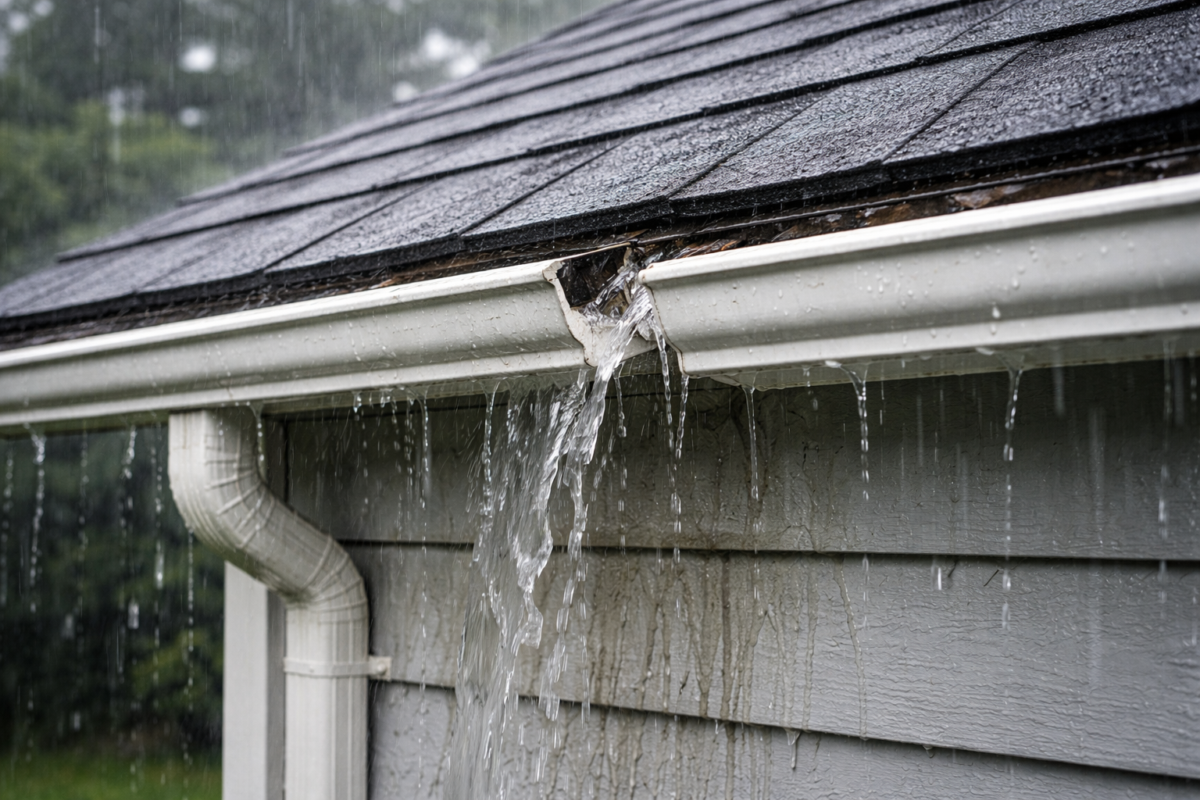
You put serious money into a new roof and finally feel like your home is protected from Oregon rain: fresh shingles, clean lines, and no more worries from above. But most people forget to look at what sits right below the roof edge, the rain gutters that carry all that water away.
A new roof helps, but it does not eliminate the need for gutter repair. In some cases, it brings gutter problems to the forefront more quickly.
Roof replacement can shift edge details, expose hidden wood damage, and increase the rate of water flow into an older drainage system. Gutter repairs often become more urgent right after a reroof, not less. There are three main reasons this keeps happening across Oregon homes.
Quick Answer
Even with a new roof, Oregon homes often need gutter repairs because reroofing can change drip-edge alignment, expose hidden fascia damage, and increase runoff speed into older gutters. A post-roof gutter inspection ensures water is captured correctly and directed away from the home before moisture damage develops.
1. The Alignment Gap: New Roof, Old Gutters
A roof and gutter system works as a pair, even though they are installed at different times. When one changes and the other does not, small gaps show up.
The Installation Process
Roof replacement usually includes new drip edge metal and updated shingle overhang at the roof edge. Manufacturer guidance indicates that the drip edge should direct water away from the roof and that shingles typically extend about 3/8 to 3/4 inch past that edge.
Fastening patterns and edge layering also change during modern reroof projects. Sometimes crews remove and reinstall gutters to make this work easier. Other times, they work around them.
Either way, the roof edge detail often ends up slightly different than before. That difference matters to rain gutters more than most people expect.
The Consequence
If the new drip edge and shingle overhang no longer align cleanly with the gutter trough, water will not drain properly. It can shoot past the gutter or slip behind it. When that happens repeatedly, the fascia board stays wet longer than it should.
Wood science guidance indicates that decay risk increases when moisture content sits around 20–25% or higher for extended periods. In a dry state, that might take a while. In Oregon, not so much.
Recent NOAA and National Weather Service data show Portland logged about 35 inches of rain in the 2024–2025 water year, close to normal, with statewide totals ranging from roughly 90% to 130% of average precipitation. A small alignment error plus steady rain equals a real problem.
The Need
This is where targeted gutter repair saves money. Minor fixes often include resealing the roof-edge-to-gutter interface, adjusting placement, or rehanging sections to improve capture. Done early, these are small jobs. Ignored, they turn into wood repair and system replacement.
2. Revealing Hidden Damage
Roof tear-offs do more than remove shingles. They expose the truth about what has been happening along the roof edge for years.
During the Roof Tear-Off
When crews strip old roofing, loose granules, fragments, and fasteners drop downward. A lot of that material lands directly in rain gutters and downspouts. Even a system that was “mostly fine” can clog fast under construction debris.
At the same time, many drainage systems, especially older ones, were never designed for today’s heavier runoff patterns. So, debris plus already-tight capacity creates instant overflow risk.
Exposing Pre-Existing Issues
Once the old roof edge is removed, contractors can clearly see the fascia boards. That is often when softwood, staining, or edge rot first appear. Long-term overflow or backflow from rain gutters commonly causes this kind of hidden damage.
Gutters depend on solid fascia for structural support. If the board is compromised, fasteners loosen, and sections sag.
The Need
After reroofing, a full inspection makes sense. Often, the solution is still modest: reinforce hangers, replace limited fascia sections, and complete a focused gutter repair. Full gutter replacement typically becomes necessary only when long runs have lost structural integrity or multiple sections have failed.
3. Increased Water Volume & Velocity
A new roof sheds water better than an old one. That sounds like a pure win until the gutter system must keep up.
Smoother Surface, Faster Flow
New shingles and clean roof surfaces create less friction. Water runs off faster and concentrates more quickly at the edge. Combine that with Pacific Northwest storm patterns, and you get a heavier surge into rain gutters during peak rainfall.
The total rainfall did not change because of the new roof. The delivery speed did.
Testing Gutter Capacity
That faster flow exposes systems that were barely adequate before. Inspection training standards often cite a typical gutter slope target of around 1/16 inch per foot. When the pitch is off, water sits instead of moving. Faster runoff makes those low spots obvious.
Overflow risk is not theoretical. FEMA’s National Flood Insurance Program reports over 101,000 flood insurance claims paid in 2024, totaling nearly $8 billion, with billions in damage occurring outside high-risk zones. Poor roof drainage contributes to those losses at the property level.
The Need
Here again, early gutter repairs are usually smaller than people expect: correcting pitch, tightening hangers, resealing seams, or improving downspout flow. Gutter replacement is more likely when gutters are undersized across the entire roofline or exhibit widespread corrosion and joint failure.
The Proactive Step: A Post-Roof Gutter Inspection
A reroof should trigger a gutter check, not a gutter assumption. The roof and rain gutters must function as a single water-control system.
Insurance data show that about 1.5% of insured homes have experienced water damage or freezing losses over the past five years. Many of those losses start with unmanaged roof runoff. A brief inspection after roof replacement can catch alignment gaps, debris buildup, and early mounting issues before they worsen.
A proper visit focuses on hanger strength, pitch accuracy, fascia condition, downspout flow, and the roof-edge interface. Most findings indicate straightforward gutter repair rather than full replacement.
The goal is to integrate the new roof and existing gutter system into a single system rather than two separate components.
Take the Next Step in Total Home Protection
Your new roof is a major investment, but Oregon’s rain has not let up. The volume continues to arrive, and the runoff still needs a path. Well-timed gutter repairs prevent minor alignment and flow issues from escalating into structural damage and a full system replacement.
At Gutter Empire, we can assess how your roof edge and rain gutters work together and handle any necessary gutter repairs before minor issues escalate. Call us at (971) 777-9899, click here for a free estimate, or contact us to schedule your post-roof gutter inspection and repair assessment.
Key Takeaways
- A new roof can change drip-edge and shingle overhang alignment, causing water to overshoot or run behind existing gutters if placement is not adjusted.¹
- Wood decay risk increases when moisture content stays around 20–25% or higher, which can happen quickly in Oregon’s persistent rain if fascia stays wet.²
- Portland recorded near-normal rainfall around 35 inches in the 2024–2025 water year, meaning even small drainage misalignments receive repeated stress.³
- Roof tear-offs often dump debris into gutters and expose pre-existing fascia rot, weakening hanger attachment points and causing sagging.¹²
- New shingles shed water faster, increasing flow velocity and revealing gutters that were already undersized or improperly pitched.¹
- Flood and water losses remain significant, with over 101,000 NFIP claims and nearly $8 billion paid in 2024, much of it outside high-risk zones, highlighting the importance of proper runoff control at the property level.⁴
- About 1.5% of insured homes experience water damage or freezing losses over a recent five-year period, and poor roof drainage is a common contributing factor.⁵
- Most post-roof issues can be solved with targeted gutter repairs—pitch correction, hanger reinforcement, resealing, and downspout flow improvements—rather than full replacement.¹
Citations
- https://www.gaf.com/en-us/document-library/documents/technical-bulletins-%26-notes/r-141-drip-edges-and-shingles.pdf
- https://www.premierbuildingsystems.com/hubfs/Premier%20SIPS/Content%20Resources/Helpful%20Links/APA-Moisture-Content-TT-111.pdf
- https://forecast.weather.gov/product.php?format=CI&glossary=1&issuedby=PDX&product=CLA&site=IWX&version=1&utm
- https://agents.floodsmart.gov/sites/default/files/media/document/2025-08/fema_nfip_media-toolkit-brochure_07-2025.pdf
- https://www.iii.org/fact-statistic/facts-statistics-homeowners-and-renters-insurance