
Most Oregon homeowners don’t think much about their gutters until water runs down the siding, pools near the foundation, or drips through a soffit. By that point, what started as a minor issue has usually already become something bigger.
The frustrating part is that much of the premature gutter repair isn’t caused by a single bad storm. It’s caused by months of accumulated moisture stress, and in many cases, it traces back to how the rain gutters were put up in the first place.
Western Oregon’s rainy season is long and relentless. Understanding why gutters fail early here means looking at a few specific failure points: seam breakdown, incorrect pitch, and fastener corrosion.
Quick Answer Summary
Premature gutter repair in wet climates like Oregon is often caused by installation issues rather than a single storm. Common problems include failing seams in sectional gutters, incorrect pitch that causes water to pool, and corroded fasteners that weaken the system’s structural support. Because Oregon experiences long periods of steady rainfall, these weaknesses are exposed quickly. Early gutter repair helps prevent water from damaging fascia boards, siding, and foundations while restoring proper drainage away from the home.
Seam Failure Starts Small and Spreads Fast
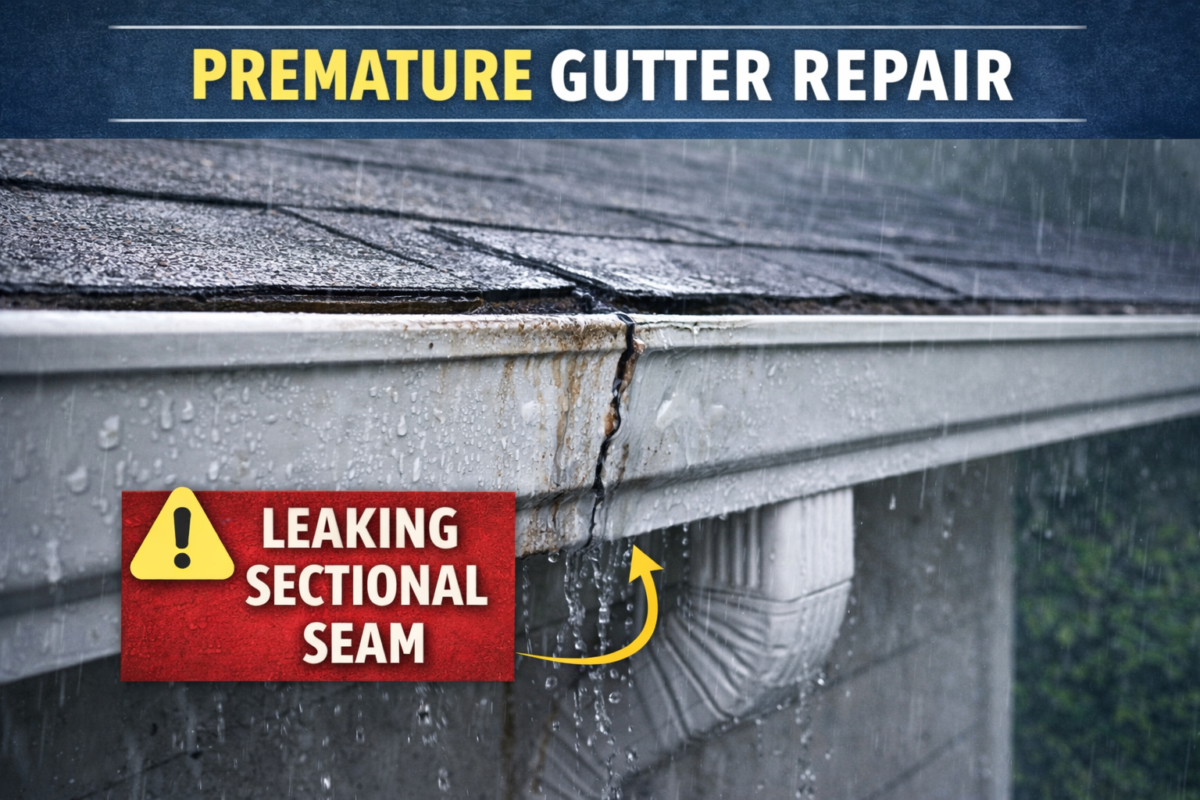
Sectional gutters, the kind installed in pieces joined together, have seams at every connection point. Those joints are sealed with waterproof sealant, but it doesn’t last forever, and in Oregon’s climate, it often fails sooner than it should.
Metal gutters shift slightly with every temperature swing, and that movement puts the most pressure on joints, end caps, and corners. Add soggy debris that slows the flow, and water lingers exactly where the system is already weakest, accelerating sagging, gaps, and leaks.
Seam leaks rarely stay where they start. One failing joint can push water behind fascia, into soffits, and down toward the foundation, and if it goes ignored long enough, that single weak point can compromise the whole system.
Early warning signs are usually subtle:
- Rust streaking near joints on steel gutters
- Chalky white corrosion pattern on aluminum near seams or fasteners
- Sealant that looks cracked or brittle
A sagging run can also signal that a joint has shifted and started carrying weight unevenly. In most cases, a professional rain gutter repair can re-secure the joint, remove the failed sealant, and reseal properly before the problem spreads.
Improper Pitch Is an Installation Problem That Rain Exposes
Gutters are supposed to slope toward the downspout. A common rule of thumb is about ¼ inch of drop for every 10 feet of gutter length, though the exact slope can vary by system and run length.
When the pitch is wrong, standing water adds unnecessary weight, increases the risk of sagging, and accelerates corrosion. During storms, pooled water spills over gutter edges, soaking siding, fascia boards, and foundations. Eventually, that added stress pulls fasteners loose and warps sections, often requiring full replacement rather than a simple repair.
Pitch problems usually come from one of three places:
- Incorrect gutter installation from the start
- Fascia board deterioration that causes the gutter to sag over time
- Structural movement over time, including settling that affects fascia alignment or drainage slope
If gutters weren’t installed with the correct pitch to begin with, the problem may not be noticeable right away. Still, over time, the slope issues become more apparent as water fails to drain properly.
Fastener Corrosion Quietly Undermines the Whole System
The screws, spikes, and brackets that attach rain gutters to the fascia board are just as important as the gutter channel itself. And in Oregon, those fasteners are under constant pressure.
Oregon tends toward steady, frequent drizzle rather than big, dramatic storms, and that’s actually harder on bracket integrity. Moisture creeps into the narrow gaps between the brackets and the fascia, and when those spots stay wet long enough, deterioration begins, regardless of how new the system is.
There’s also a material compatibility issue worth knowing about. Galvanic corrosion occurs when two dissimilar metals come into contact in the presence of water. For example, aluminum gutters connected with steel fasteners corrode faster when exposed to moisture. This kind of corrosion is common in systems that weren’t designed with wet-climate fastener matching in mind.
What makes bracket failure so easy to miss is that everything can look fine from the outside while the connection is already going. A fastener that’s lost its real grip won’t hold long after tightening because movement comes back fast. And if the fascia has been quietly absorbing moisture, the wood loses its ability to hold anything securely, no matter what the hardware looks like.
Most Premature Repairs Trace Back to How Gutters Were Installed
It’s easy to blame Oregon’s weather for everything. But many early gutter repair needs stem from installation decisions that weren’t designed to withstand sustained moisture.
Professional installers calculate gutter pitch based on roof length, downspout placement, and drainage needs. Experienced contractors reduce the risk of errors that compromise performance and shorten system lifespan. That kind of precision matters everywhere, but in Oregon, it can be the difference between a gutter system that holds up for years and one that starts showing avoidable problems far too early.
Seamless gutters are fabricated on-site as a continuous run, which means far fewer joints where leaks can develop over time. Mismatched fastener materials, inadequate sealing at end caps and corners, and even small dents from poor handling can strip protective coatings, leaving metal exposed to Oregon’s moisture long before the system should show wear.
What Timely Rain Gutter Repair Actually Protects
The downstream consequences of ignoring gutter problems are almost always worse than the repair itself. Water that escapes the system doesn’t disappear. It goes somewhere. And in Oregon’s persistently wet conditions, it has plenty of time to work its way into fascia boards, soffits, wall cavities, and foundations before anyone notices.
According to HomeAdvisor’s 2025 cost data, water damage restoration averaged about $3,867, with many projects falling between $1,384 and $6,384, though actual costs vary widely based on severity.
Timely rain gutter repair doesn’t just stop the drip. It restores the way the whole system carries water away from the house, protecting fascia, soffits, siding, and foundation from the kind of slow, repeated moisture exposure that leads to rot, mold, and structural repair bills that are a lot harder to absorb.
Protect Your Home Before the Next Rainy Season Starts
Oregon’s climate doesn’t give gutters much of a break. From late fall through spring, rain gutters operate almost continuously, and every failure point discussed above worsens with each passing wet season without attention.
The good news is that catching these issues early, especially after a gutter installation or before the rainy season ramps up, is almost always more manageable than dealing with the structural damage that follows. Knowing what early warning signs look like puts you ahead of most problems before they escalate.
If your gutters are showing any of these signs, Gutter Empire is ready to help. Contact us at (971) 777-9899, click here for a free estimate, or reach out through our contact form to schedule an inspection before the next rainy stretch arrives.
Key Takeaways
- Premature gutter failure in wet climates often stems from installation issues such as seam breakdown, improper pitch, and fastener corrosion rather than a single weather event.
- Sectional gutters contain multiple seams that rely on sealant, which can crack or deteriorate over time, especially when exposed to prolonged moisture.
- Proper gutter pitch is essential; systems generally require approximately ¼ inch of slope per 10 feet so gravity can direct water toward the downspouts.
- Standing water caused by poor pitch increases weight on the system, which can pull fasteners loose and accelerate metal corrosion.
- Galvanic corrosion can occur when dissimilar metals (such as aluminum gutters and steel fasteners) remain in contact in a wet environment, weakening brackets and anchors.
- Seamless gutters reduce potential failure points because they eliminate most joints where leaks commonly begin.
- Ignoring gutter issues can lead to expensive damage. Average water damage restoration costs about $3,867, with many repairs ranging from $1,384 to $6,384 depending on severity.¹
Citations
- HomeAdvisor – Water damage repair cost data – https://www.homeadvisor.com/cost/disaster-recovery/repair-water-damage/